Understand
Fasting blood sugar
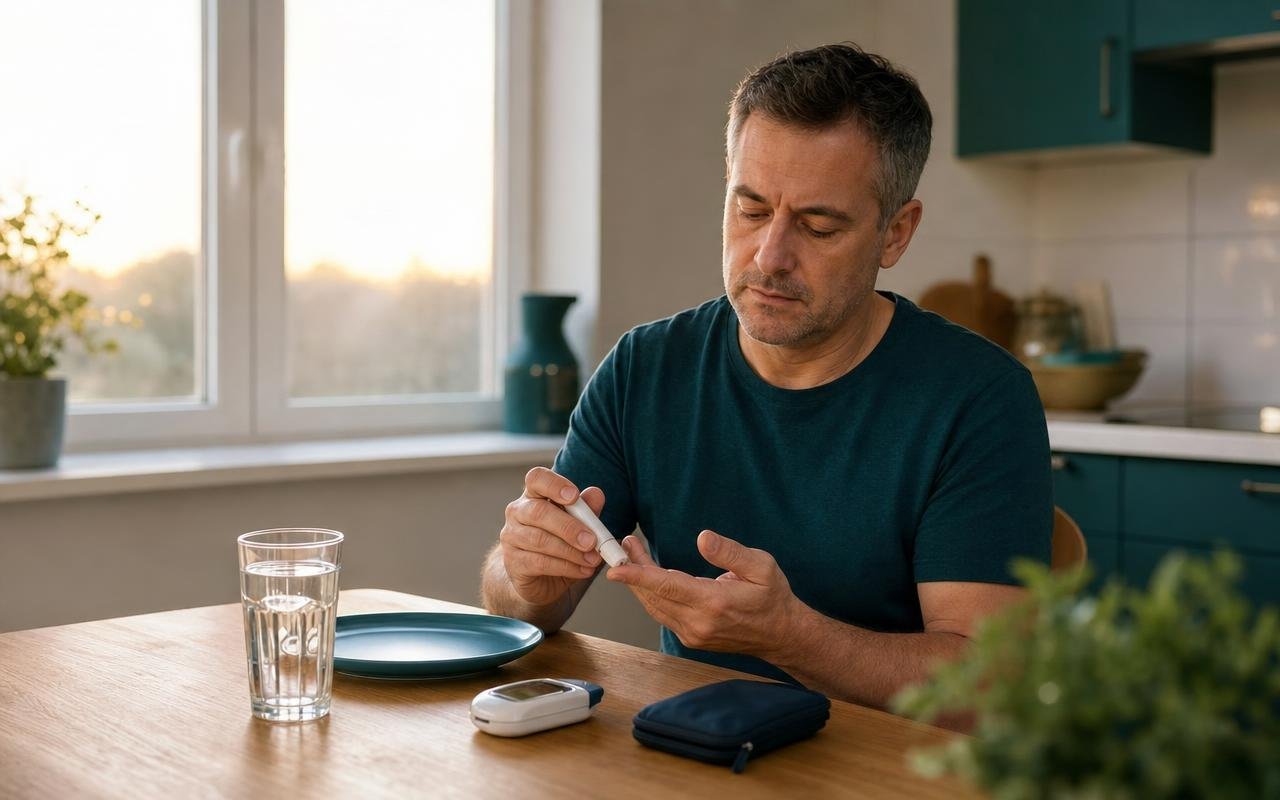
Fasting blood sugar is the level after at least 8 hours without food — in practice, the number your meter or lab shows first thing in the morning. Normal is 70–99 mg/dl (3.9–5.5 mmol/L); 100–125 is the prediabetes range; 126 and above, confirmed at a lab on a second occasion, is the diabetes threshold.
Why fasting is the reference measurement
Every reading taken during the day carries the fingerprint of the last meal — what you ate, how much, and how long ago. After 8 hours without food that variable is gone, and what remains is the body's own baseline: overnight, the liver releases glucose at a steady drip and insulin keeps it in range. The fasting number shows how well that regulation works with nothing else going on.
That is why it anchors the diagnostic chart (the full classification is in normal blood sugar levels), why it is the standard first test on a routine blood panel, and why it is the most comparable number you can track over time — a fasting 95 in March and a fasting 95 in June were measured under the same conditions in a way two random afternoon readings never are.
How to take a fasting reading correctly
- 8 hours minimum without calories. The practical version: nothing after dinner, test before breakfast. Longer than 12–14 hours is unnecessary and can itself nudge the number.
- Water is fine — drink it freely. Coffee or tea with milk or sugar is not; even black coffee is better saved for after the test if the reading needs to be exact.
- Test soon after waking. The longer the morning runs on, the more stress hormones and that first coffee blur the picture. Before breakfast, before the shower-and- commute rush, is the cleanest window.
- Wash and dry your hands with plain water. Residue on a fingertip is the single most common cause of a falsely high reading — the rest of the technique details are in how to test blood sugar at home.
- Keep the conditions constant. Same time, same routine. A fasting log is only as comparable as its circumstances — the journal is built for exactly this kind of series.
What raises fasting blood sugar overnight
A high morning number does not necessarily mean last night's dinner was the problem — by morning, dinner is long processed. The usual suspects:
- The dawn phenomenon. In the early morning hours the body releases cortisol and growth hormone to prepare for waking, and both push the liver to release glucose. In people with insulin resistance, that surge is not fully countered, and the waking reading lands higher than the bedtime one. The dawn phenomenon article covers when it matters and what helps.
- A large or late dinner — especially one heavy in fat and carbohydrate, which digests slowly enough to still be raising glucose at 2 a.m.
- Poor sleep. A short or fragmented night raises insulin resistance the next morning; one bad night can move the reading by a noticeable margin.
- Illness, pain and stress. All raise cortisol, and cortisol raises glucose. A fasting reading taken during a flu says little about your baseline.
- Medication effects — steroids are the classic example. In people on insulin, a mistimed or insufficient evening dose shows up in the morning number too.
Fasting glucose vs A1C
The two tests answer different questions. Fasting glucose is a snapshot: one morning's baseline, sensitive to yesterday's sleep, stress and dinner. A1C is the average over roughly three months, blind to individual days. That is why they can disagree — a normal A1C with a creeping fasting number, or the reverse — and why doctors often order both: the snapshot shows where regulation is starting to slip, the average shows how much it matters day to day. Neither replaces the other; how they fit together is the subject of A1C and blood sugar.
When one high fasting reading matters — and when it doesn't
A single fasting reading of, say, 108 on a home meter is weak evidence on its own. The meter's allowed ±15 % error means a true 95 can display as 108; a short night or a stressful week can produce the same result honestly. One isolated high morning, in someone who feels fine, calls for a re-test on a few more mornings — not for conclusions.
A pattern is different. Fasting readings that repeatedly land at 100 mg/dl or above are worth a lab test and a look at what the prediabetes range means. Any reading at 126 mg/dl or above belongs at the doctor's office for lab confirmation — remember that diagnosis always requires a lab value confirmed on a second occasion, never a home meter alone. And a fasting reading below 70 counts as hypoglycemia, which has its own rules.
Putting it into practice
- Test on three to five consecutive mornings under the same conditions — 8 hours fasted, water only, washed hands, before breakfast.
- Log each value with a note on sleep and anything unusual, and read the series as a whole, not morning by morning.
- Averages under 100: nothing to do beyond an occasional check. Repeatedly 100–125: book a lab test. Any confirmed 126 or above: see your doctor.
- If mornings run high while daytime readings look fine, read up on the dawn phenomenon before changing anything about dinner — the cause may be hormonal, not dietary.
Sources
- Standards of Care in Diabetes — 2026 — American Diabetes Association
- Diabetes — Fact sheet — World Health Organization
- About Diabetes — Testing — Centers for Disease Control and Prevention
Educational information, not medical advice.