Act
Vegetables and blood sugar
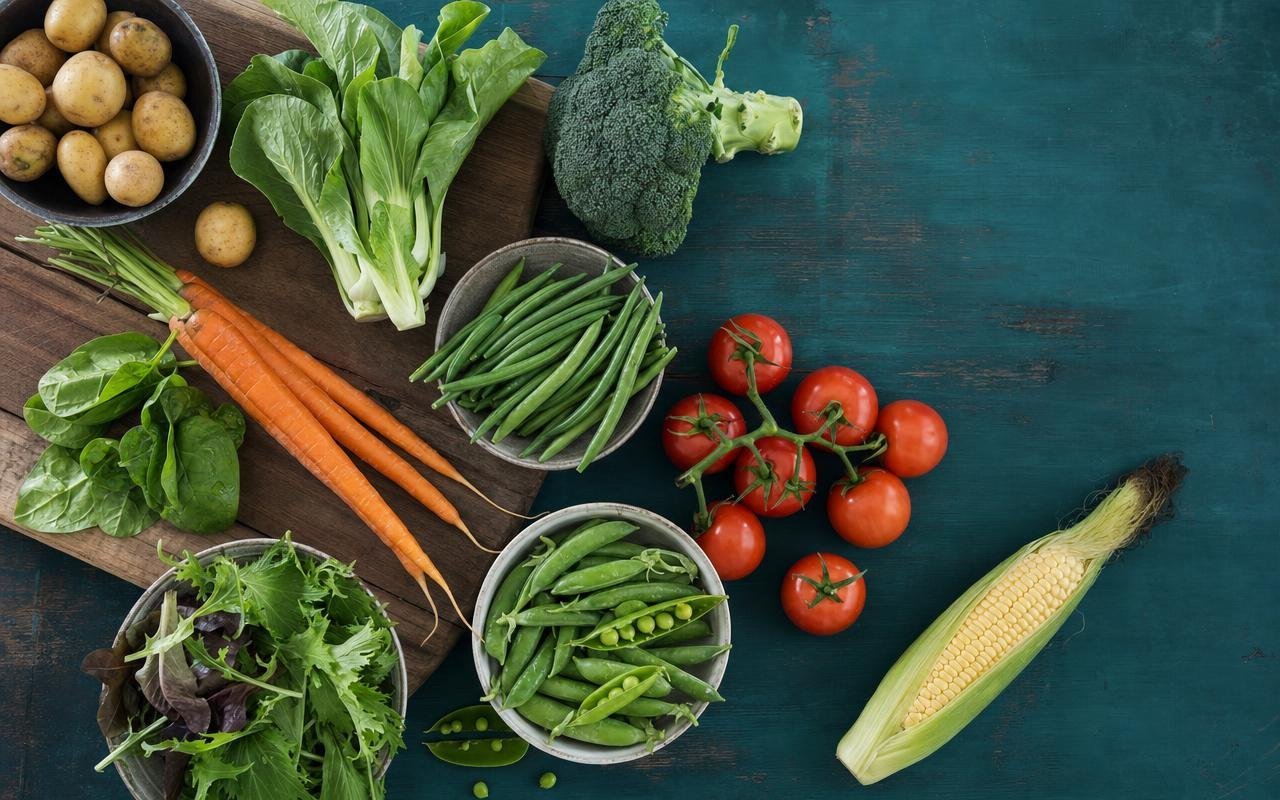
Most vegetables barely move blood sugar at all — spinach, broccoli, celery and tomatoes are as close to a free food as eating gets. The exceptions are the starchy ones: potatoes and corn behave like bread and rice and have to be counted like them. This page draws that line precisely, with GI and glycemic load values for the vegetables people actually ask about.
The split that matters: non-starchy vs starchy
Non-starchy vegetables — leafy greens, broccoli, cauliflower, celery, tomatoes, peppers, zucchini, green beans, carrots — hold so little carbohydrate per serving that many cannot even be assigned a glycemic index (a GI test requires feeding 50 g of available carbohydrate; with spinach, that would take pounds of it). Their glycemic load per serving rounds to zero or one. Eat them freely.
Starchy vegetables — potatoes, corn, and to a lesser degree peas and winter squash — store energy as starch, which is just glucose in chains. A medium potato carries about as much available carbohydrate as three slices of bread. Nothing wrong with that, but it means they count as the carb portion of the meal, not as the vegetable.
GI and GL: the vegetable table
GI ranks how fast the carbohydrate raises glucose (glucose = 100); glycemic load (GL) factors in how much carbohydrate a serving actually holds, which makes it the number that predicts your reading. Under 10 per serving is low, 11–19 medium, 20 and above high.
| Vegetable | GI | Typical serving | GL per serving |
|---|---|---|---|
| Spinach, celery, broccoli, green beans | too little carb to test | 1 cup | ~0 (low) |
| Tomatoes | ~15 | 1 medium | 1 (low) |
| Carrots, raw or boiled | 16–39 | ½ cup | 2 (low) |
| Green peas | 48 | ½ cup | 3 (low) |
| Sweet corn | 52 | 1 ear / ¾ cup | 9 (low) |
| Sweet potato, boiled | ~61 | 1 medium | ~11 (medium) |
| Potato, boiled, then cooled | ~56 | 1 medium | ~12 (medium) |
| Potato, boiled, eaten hot | 78 | 1 medium | 17 (medium) |
| French fries | 63–75 | medium serving | ~21 (high) |
| Mashed potatoes (incl. instant) | 83–87 | 1 cup | ~24 (high) |
Values from the international GI tables (glucose = 100); measurements vary by variety and study, typically by ±5–10 points. The table's real lesson sits in its bottom half: the same potato spans GI 56 to 87 depending on nothing but preparation. Mashing pre-digests it mechanically; frying adds fat that slows things slightly but brings its own load; a baked russet lands around 85 or higher.
The carrot myth
Carrots spent decades on "avoid" lists because of a single 1981 measurement that put their GI at 92 — a small early study that later, better measurements never reproduced. Modern values run around 39 for boiled carrots and lower for raw. And even if the GI were high, the load never could be: half a cup of carrots holds about 5 g of available carbohydrate, for a GL of 2. No one has ever spiked on carrots. Eat them without arithmetic.
Cooked vs raw, and the cooling effect
Cooking bursts plant cell walls and gelatinizes starch, so cooked versions of the same vegetable digest faster than raw — boiled carrots measure higher than raw ones, and the longer pasta or potatoes cook, the higher they climb. For non-starchy vegetables the difference is academic (twice almost-nothing is still almost nothing). For starchy ones it is worth knowing the reverse trick too: when cooked potatoes, rice or pasta cool, part of the gelatinized starch re-crystallizes into resistant starch, which digests slowly or not at all. A boiled potato eaten cold in a salad measures around GI 56 versus 78 hot — and a vinegar-based dressing nudges the response down further. Reheating undoes some, but not all, of the effect, which is why day-old potato or pasta salad is genuinely gentler than the same food fresh from the pot.
How to fit potatoes and corn into a meal
- Count them as the carb, not the vegetable. Potato or corn takes the quarter of the plate that bread or rice would have taken — not the vegetable half.
- Keep the portion defined. One medium potato or one ear of corn is a reasonable carb portion; the trouble starts with the second helping of mash.
- Choose the gentler forms. Boiled or cooled beats mashed, instant and fried; corn on the cob beats corn processed into anything.
- Never eat them naked. Protein, fat and the vegetables eaten first all flatten the curve — the sequence trick is measured out in foods that steady your glucose.
- Walk after. Ten minutes of walking after a starchy meal visibly lowers the peak — see exercise and blood sugar.
Half the plate, and how to check your own numbers
The working rule for everything above the starchy line: make non-starchy vegetables half of every lunch and dinner plate. They add volume, fiber and minerals for almost no glucose cost, and whatever space they occupy, refined carbs no longer do. If you want proof rather than rules, run the experiment on yourself: eat your usual potato or corn dish, test 2 hours after the first bite, and compare with 140 mg/dl, the normal post-meal line — then repeat with the cooled or halved version and log both readings in the journal. Two strips will tell you more about your potatoes than any table. Fruit runs by similar rules with different numbers — fruit and blood sugar has that table.
Sources
- Standards of Care in Diabetes — 2026 — American Diabetes Association
- Diabetes — Fact sheet — World Health Organization
- About Diabetes — Testing — Centers for Disease Control and Prevention
Educational information, not medical advice.