Act
Foods that steady your glucose
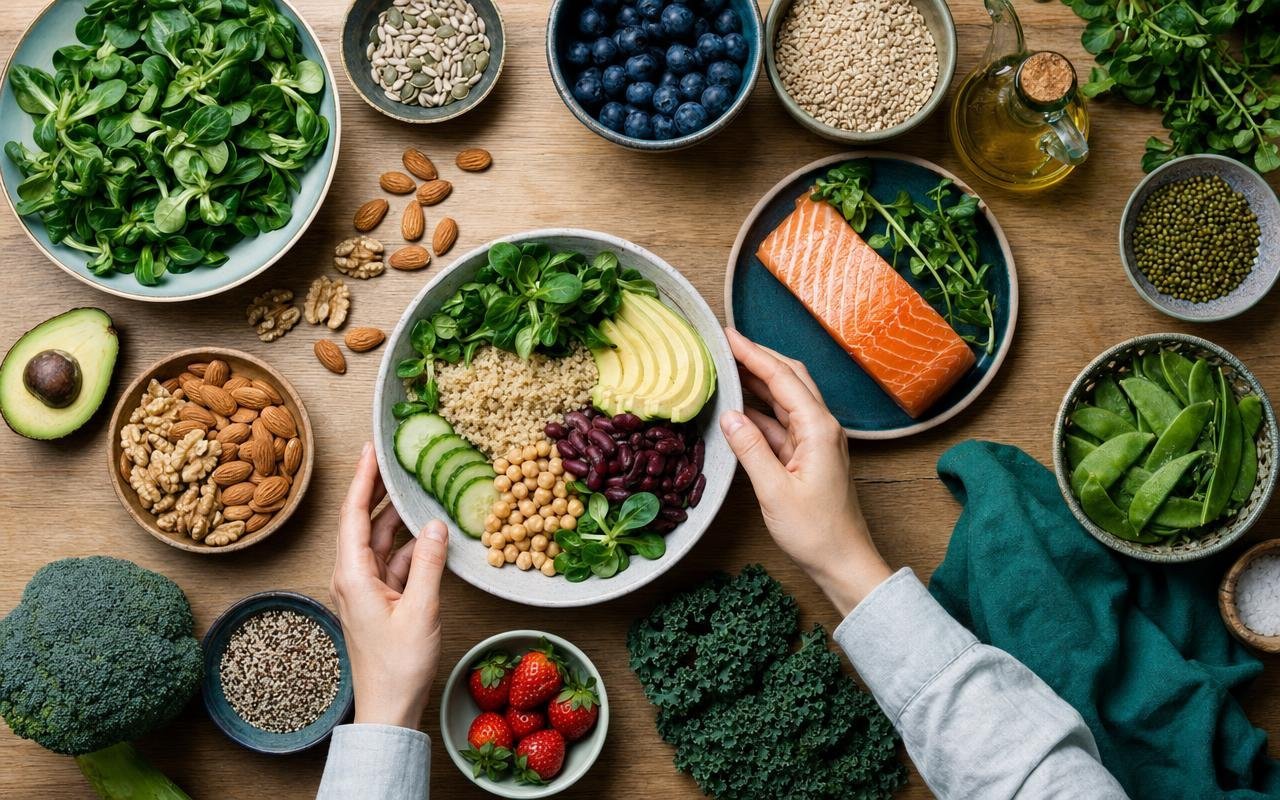
No food lowers blood sugar the way medication does — but what you eat, and even the order you eat it in, decides how high your glucose climbs after every meal. This page covers what to eat more of, what reliably spikes you, and the swaps that change the curve without turning eating into a project.
Eat more of these
- Non-starchy vegetables — leafy greens, broccoli, peppers, tomatoes, zucchini, cauliflower. Almost no glucose impact, plenty of fiber and volume. Half the plate is the working rule.
- Protein — fish, poultry, eggs, tofu, Greek yogurt, cottage cheese. Protein barely raises glucose and slows the absorption of the carbohydrate eaten alongside it. A meal without protein is a meal that spikes harder.
- Legumes — lentils, chickpeas, black beans. Carbohydrate, yes, but wrapped in fiber and protein, so it arrives slowly. Among the best-tested foods for flattening post-meal glucose.
- Nuts and seeds — minimal glucose impact, and adding them to a carb-containing meal blunts the rise. A handful, not the whole bag: they are calorie-dense.
- Whole, intact grains — steel-cut oats, barley, farro, quinoa, brown rice. "Intact" is the key word: the more a grain is ground and processed, the faster it digests. Whole-wheat flour products sit closer to white bread than to barley.
What spikes you
Two categories do most of the damage:
- Refined carbohydrates — white bread, white rice, most breakfast cereals, pastries, crackers, instant anything. Stripped of fiber, they digest nearly as fast as sugar itself.
- Liquid sugar — soda, sweetened coffee drinks, sports drinks, and juice, including 100 % fruit juice. Liquid needs no digestion; a large glass of juice hits the bloodstream in minutes. A whole orange, with its fiber intact, behaves far better than the juice of three.
Neither category is poison, and no food deserves demonizing — but these are the ones to displace first, because they buy the least fullness per spike.
Meal order: an odd trick that actually measures out
Eating the vegetables and protein on your plate before the bread, rice or potatoes lowers the post-meal peak — in small controlled studies in people with type 2 diabetes, by roughly a third at the half-hour and one-hour marks compared with eating the carbohydrate first. Same food, same amounts, different sequence. The fiber and protein slow stomach emptying, so the carbohydrate trickles in instead of flooding.
It costs nothing to try, and it is one of the easiest things to verify on yourself: test 2 hours after the same meal eaten both ways on different days and log the pair (the journal here works for that). Under 140 mg/dl at 2 hours is the normal post-meal line — more on the curve itself in blood sugar after eating.
The glycemic index: useful, within limits
The glycemic index (GI) ranks carbohydrate foods by how fast they raise glucose — glucose itself scores 100, lentils around 30. As a rough sorting tool it works: it is why barley beats cornflakes. But it has real limits:
- It ignores portion size. Watermelon has a high GI but little carbohydrate per slice; a modest serving barely registers.
- It was measured on foods eaten alone. Add protein, fat or vinegar and the number changes. Real meals are mixed meals.
- Preparation moves it. Pasta cooked al dente scores lower than overcooked; a ripe banana higher than a green one.
- People differ. The same food can produce visibly different curves in two people. Your meter outranks any table.
Use GI to choose between similar foods, not as a rulebook.
Realistic swaps
- White rice → barley, farro, or lentils mixed half-and-half with the rice
- White toast → dense whole-grain or sourdough bread, one slice, with eggs
- Sweetened cereal → steel-cut oats with nuts and berries, or plain Greek yogurt
- Juice or soda → water, sparkling water, unsweetened tea or coffee — and whole fruit when you want fruit
- Mashed potatoes → roasted cauliflower, beans, or half the potato portion plus extra vegetables
- Crackers or chips as a snack → a handful of nuts, cheese, or vegetables with hummus
Swaps beat bans: each one keeps the meal recognizable, which is what makes it survivable past week two.
Why "no carbs ever" is not the advice
Cutting refined carbohydrate helps almost everyone with elevated glucose. Cutting all carbohydrate is a different claim. Legumes, intact grains, fruit and dairy carry fiber, protein and nutrients along with their carbohydrate, and diets that keep them — Mediterranean-style eating is the best-studied — improve glucose and heart outcomes without requiring the elimination of entire food groups. Very-low-carb diets do lower glucose and suit some people, but they demand more, are harder to sustain, and are genuinely risky to start unannounced if you take insulin or a sulfonylurea — the doses that matched your old meals can now drive you low. Any major diet change on those medications starts with a care-team conversation.
How to put this on a plate
One template covers most meals: half the plate non-starchy vegetables, a quarter protein, a quarter intact carbohydrate — eaten roughly in that order, water to drink. Change one meal at a time, starting with whichever currently leans hardest on refined carbs or sugary drinks (breakfast, for many people). Then let your own 2-hour readings — not a food blogger — tell you what your next swap should be. Food is half the picture; the walk that follows the meal is the other half: exercise and blood sugar.
Sources
- Standards of Care in Diabetes — 2026 — American Diabetes Association
- Diabetes — Fact sheet — World Health Organization
- About Diabetes — Testing — Centers for Disease Control and Prevention
Educational information, not medical advice.