Measure
How to test blood sugar at home
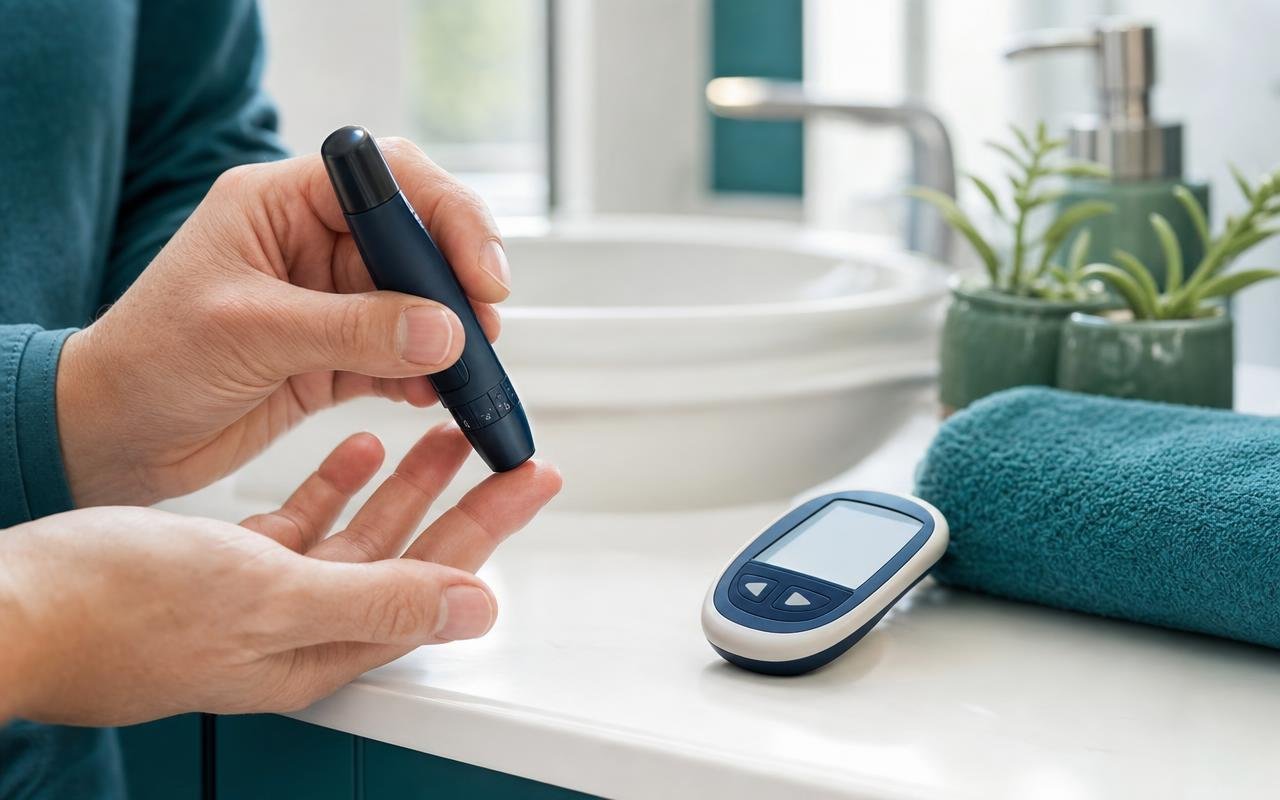
A home fingerstick takes thirty seconds, but small technique errors routinely move the result by 20 mg/dl or more — enough to turn a normal reading into a scary one. This page walks through the test step by step, the mistakes that actually distort numbers, and when a surprising reading deserves an immediate re-test.
Step by step
- Wash your hands with soap and warm water, then dry them completely. Water — not hand sanitizer. Sugar residue on a fingertip is the single biggest source of false highs: handling fruit, juice or anything sweet can inflate a reading by tens or even hundreds of mg/dl. Sanitizer does not remove that residue, and undried alcohol on the skin can itself skew the result. Warm water also brings blood to the fingertips, so the drop comes easier.
- Insert a fresh strip into the meter and check it turns on ready. Use a new lancet — a dull one hurts more and tears rather than pricks.
- Prick the side of the fingertip, not the pad. The sides have fewer nerve endings and a good blood supply; the pad is where you touch everything all day and where soreness is felt most.
- Get a hanging drop. If it comes slowly, hold the hand low and gently press from the base of the finger toward the tip. Do not squeeze or "milk" hard at the puncture — forcing it dilutes the blood with tissue fluid and can shift the reading, typically downward, by 5–10 %.
- Touch the drop to the strip's edge and let it draw the blood in. A too-small drop causes an error message on most modern meters, but on some it causes a falsely low number instead — if the strip did not fill in one go, discard it and repeat.
- Rotate fingers and sides between tests. Testing several times a day on the same spot builds calluses and soreness; six fingers with two sides each gives twelve sites to cycle through (many people spare thumb and index finger).
First drop or second drop?
With freshly washed and dried hands, the first drop is fine — studies comparing the two found no meaningful difference. If washing is genuinely impossible (on the road, no water), wipe the first drop away with a clean tissue and test the second: that removes most surface contamination, though it is a fallback, not an equal substitute for washing.
Strips and meters: the hardware side
- Storage: strips live in their original vial, tightly closed, at room temperature. Humidity and heat degrade the enzyme on the strip — a bathroom shelf or a hot car ruins strips that look perfectly normal, and damaged strips misread unpredictably.
- Expiry: check the date on the vial, and note that some brands also limit how long a vial may be open (often 3–6 months). Expired strips tend to read low.
- Accuracy: regulators allow home meters an error of ±15 % against a lab value. A true 100 mg/dl may legitimately show as anything from 85 to 115. Two readings taken minutes apart can differ noticeably with nothing wrong — which is why single odd numbers matter less than patterns, and why home meters never diagnose diabetes. Diagnosis requires a lab test, confirmed on a second occasion.
When to test
The two moments that map onto the ADA classification ranges:
- Fasting: in the morning, after at least 8 hours without food. Normal is 70–99 mg/dl. The details are in fasting blood sugar.
- 2 hours after a meal — timed from the first bite, not the last. Normal is below 140 mg/dl; see blood sugar after eating.
How often to test is individual: people on insulin test several times daily by plan; someone watching prediabetes may test paired readings (before and 2 hours after the same meal) a few times a week to learn which meals spike them.
Common errors and roughly what they cost
| Error | Typical effect on the reading |
|---|---|
| Sugar residue on fingers (fruit, juice, cream) | Falsely high — from tens of mg/dl to absurd triple-digit errors |
| Hand sanitizer or alcohol not fully dried | Distorted either way, usually modest but unpredictable |
| Hard squeezing at the puncture | Falsely low, roughly 5–10 % |
| Heat- or humidity-damaged strips, expired strips | Unpredictable, often falsely low |
| Underfilled strip (on meters that accept it) | Falsely low |
| Wet hands diluting the drop | Falsely low |
| Testing at 1 hour instead of 2 after a meal | Reads high against the 140 mg/dl benchmark — a timing error, not a glucose problem |
When a surprising number deserves an immediate re-test
Any reading that does not fit — you feel fine at 55, or you get a 280 an hour after a salad — gets one immediate response: wash your hands with plain water, dry them, and re-test with a fresh strip. Most outliers disappear on the second measurement. If the number confirms, take it seriously:
Make the numbers add up to something
A single reading is a snapshot with a ±15 % blur. The value is in the series: the same measurement, taken the same way, over days. Log each reading with its context — fasting or after which meal — in the on-device journal here, and patterns emerge that one number never shows: which breakfast spikes you, whether mornings run high, whether the walk after dinner works. That series, not any single fingerstick, is what your doctor can actually act on. And if your meter or your records mix units, mg/dL vs mmol/L sorts that out in one division.
Sources
- Standards of Care in Diabetes — 2026 — American Diabetes Association
- Diabetes — Fact sheet — World Health Organization
- About Diabetes — Testing — Centers for Disease Control and Prevention
Educational information, not medical advice.