Understand
What affects blood sugar
Food gets the blame for most surprise readings, but glucose also answers to stress hormones, infections, lost sleep, the menstrual cycle, a long list of medications and even the weather. This page goes through the non-food factors one by one — which direction each pushes, roughly how hard, and what to do about it.
Stress: the liver takes orders from your hormones
Cortisol and adrenaline exist to prepare you for effort, and part of that preparation is telling the liver to release stored glucose while making muscle temporarily insulin-resistant. An argument, a deadline or a hospital visit can put a visible bump in the next reading; a hard week shows up in the weekly average. The effect is real but usually modest — smaller than what food, movement or medication do — and it fades when the stressor does.
What to do: don't judge a reading taken in the middle of a bad day as if it were a quiet Sunday morning. Note the context, and treat stress reduction as a supporting move, not the main plan — the levers that move glucose most are ranked in how to lower blood sugar.
Illness and infection: highs often come before the fever
Fighting an infection triggers the same counter-regulatory hormones as stress, only harder and for days. A cold, the flu, a urinary tract infection or an infected tooth can push readings up substantially even when you are eating less than usual — and the rise often appears a day or two before other symptoms, which is why an unexplained run of highs is worth taking seriously.
Sick-day basics: test more often (every 3–4 hours is a common recommendation), drink water steadily, and keep taking your medication unless your care team says otherwise — insulin needs usually go up during illness, not down, even if you are barely eating. People with type 1 diabetes should check ketones whenever they are ill.
Sleep: short nights make insulin work worse
Sleep deprivation raises cortisol and measurably reduces insulin sensitivity — in experiments, restricting healthy adults to 4–5 hours a night for less than a week worsens their glucose handling. In daily life that shows up as higher fasting readings after short or broken nights, without any change in what you ate. Untreated sleep apnea — loud snoring, gasping, daytime exhaustion — pushes glucose up independently and deserves its own medical conversation. If your mornings run high despite decent eating, look at sleep before blaming breakfast.
Hormones: the menstrual cycle and menopause
In the luteal phase — the week or so between ovulation and the period — rising progesterone makes many women temporarily more insulin-resistant, so readings run higher on the same food and drop back once the period starts. The size of the effect varies a lot between women but tends to repeat cycle after cycle in the same person, which makes it predictable: track two or three cycles with cycle days noted, and the pattern is usually obvious. Women who use insulin sometimes need different doses across the cycle — a care-team conversation, with the log as evidence.
Around menopause, falling estrogen nudges insulin resistance up, while hot flashes and broken sleep add noise of their own. Readings often become more variable before they become higher; the same tracking approach applies.
Medications that move blood sugar
The classic riser is corticosteroids — prednisone and relatives, whether for asthma, joints or an autoimmune condition. The effect is strong and dose-dependent: readings can climb steeply, typically peaking in the afternoon and evening after a morning dose, and settle again after the course ends. Anyone with diabetes or prediabetes starting steroids should plan extra testing with the prescriber up front.
Smaller but documented raisers include thiazide diuretics, some antipsychotics (olanzapine and clozapine are the notable ones) and statins — the statin effect averages only a few mg/dl, and in trials the heart protection clearly outweighs it, so it is a reason for awareness, never a reason to stop on your own.
On the lowering side sit the diabetes medications themselves — with insulin and sulfonylureas carrying a real risk of hypoglycemia when meals, doses and activity don't line up. Alcohol lowers glucose too, hours later and especially on an empty stomach. And beta-blockers don't lower glucose, but they can mute the shakiness and racing heart that warn of a low. The one rule covering all of this: never start, stop or re-dose anything yourself — bring your full medication list, supplements included, to the next appointment.
Three quieter factors
- Time of day. Morning readings routinely run higher than the bedtime before, because early-morning hormones tell the liver to release glucose. That pattern has its own name and its own page: the dawn phenomenon.
- Dehydration. Less water in the blood means the same glucose is more concentrated, and the kidneys need fluid to clear the excess — so running dry pushes readings modestly up. It compounds with illness and heat, which both dehydrate you.
- Heat. Hot days cut both ways: dehydration pushes readings up, while heat speeds insulin absorption and can trigger lows in insulin users. Heat also damages test strips and insulin — neither belongs in a parked car.
How to tell signal from noise
Home meters are allowed a ±15 % error, so two honest readings minutes apart can differ noticeably — no single number proves anything. To find out what is actually moving your glucose:
- Change one thing at a time. An earlier dinner, a post-meal walk, a steroid taper — one variable per experiment, or you learn nothing.
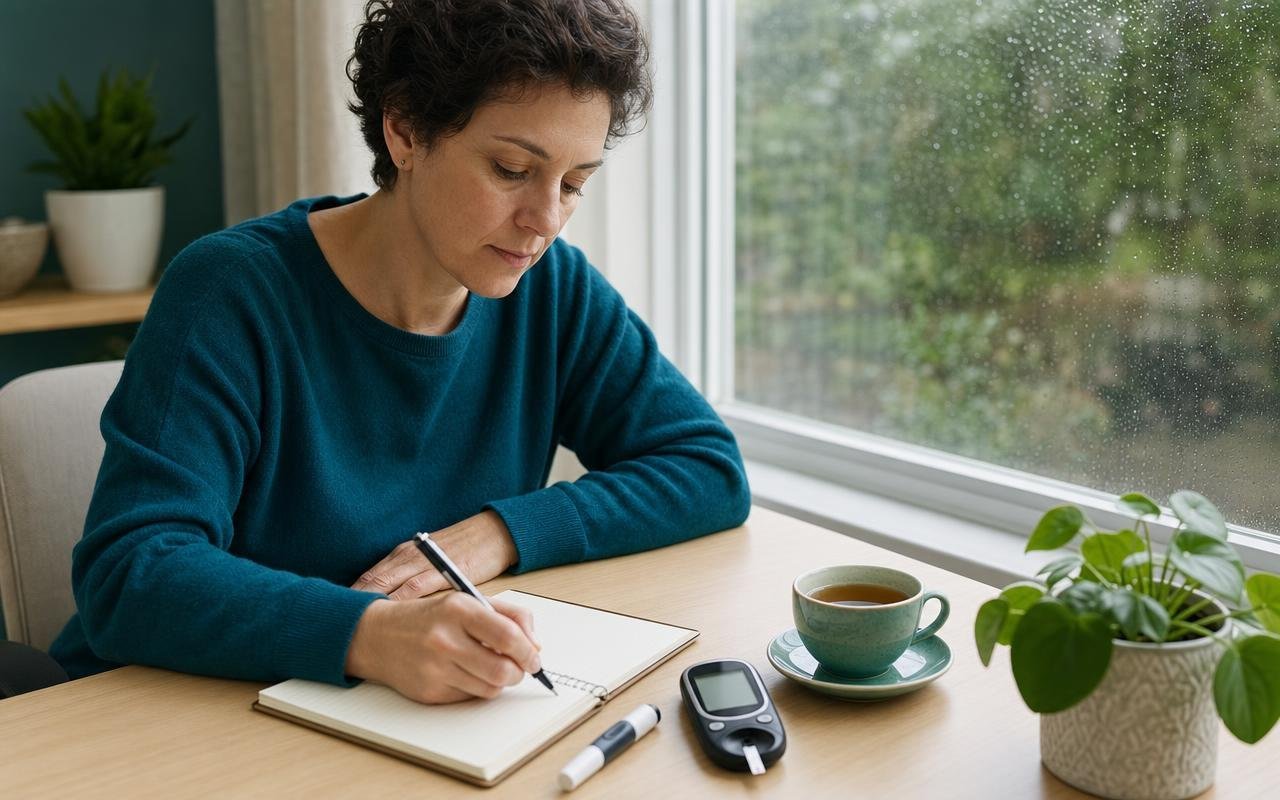
- Log the context, not just the number. Sleep, stress, illness, cycle day, new medications. The journal here is built for exactly that.
- Judge trends over weeks, not days. A pattern across ten readings with context attached is something a doctor can act on; one odd Tuesday is not.
Sources
- Standards of Care in Diabetes — 2026 — American Diabetes Association
- Diabetes — Fact sheet — World Health Organization
- About Diabetes — Testing — Centers for Disease Control and Prevention
Educational information, not medical advice.